
EBStatMax is a “demonstration project” funded by the European Joint Programme on Rare Diseases, aimed at bridging the gap between challenges arising from clinical practice and their potential statistical solutions. An international team of statisticians analysed a dataset from a recent clinical trial on Epidermolysis Bullosa (EB) using different state-of-the-art methodologies. The team provided recommendations for future trials, implemented computational tools for practitioners and created educational materials.
In a randomized, placebo-controlled, 2-period crossover phase 2/3 trial, the immunomodulatory impact of 1% diacerein cream vs. placebo in reducing the number of blisters in EB was assessed. 15 patients were randomized to either placebo or diacerein for a 4-week treatment and a 3-month follow-up in period 1. After a washout, patients were crossed over during period 2. Of the patients receiving diacerein, 86% in episode 1 and 37.5% in episode 2 met the primary end point, i.e., a reduction of number of blisters by more than 40% from baseline in selected areas over the treatment episode (vs 14% and 17% with placebo, respectively).

From a statistical point of view, small sample sizes represent a major challenge in drawing conclusions from that trial. Since this is a frequently encountered situation in rare diseases research in general, a methodologically sound consideration of alternative analysis options, which make use of the limited information in an optimized way, can provide valuable methodological guidance that might be applicable to any rare disease.
Simulation studies were used in EBStatMax to compare different statistical approaches, ranging from parametric to semi- and nonparametric methods. More specifically, nparLD, GPC variants, GEE, and model averaging methods were compared, as those were considered promising methods to account for longitudinal, period, carry-over or cross-over effects. Based on these systematic simulation-based comparisons, recommendations were derived.
Moreover, to facilitate understanding of these non-traditional statistical methods (especially for non-statisticians), another goal of EBStatMax is to create educational materials and develop a user-friendly web application that implements the methods which performed well in the simulation-based comparisons.

Based on our simulations, various methods could be identified as viable alternatives to conventional methods. Our results reveal that there is no one single best method, since in many cases a trade-off between achieving high power, accounting for cross-over period effects, and missing data is required. However, nonparametric approaches often perform better with small sample sizes than conventional methods.

Based on our simulations, the prioritized unmatched GPC method was able to achieve particularly high power values and yielded good results in many cases. This multivariate approach allows to analyze count, binary and ordinal outcomes, and to prioritize them by time point. For each pair, a score is assigned to the first ranked time point. If and only if the score results in a tie, the next ranked time point is evaluated, continuing until the last time point.

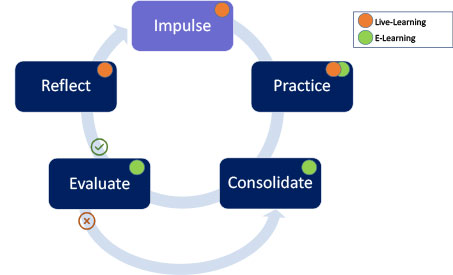
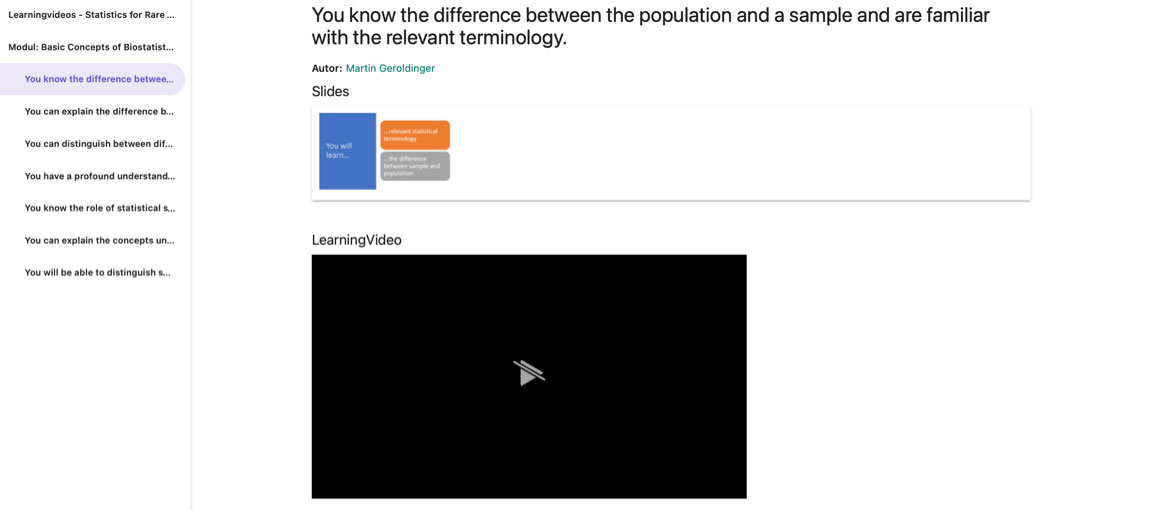
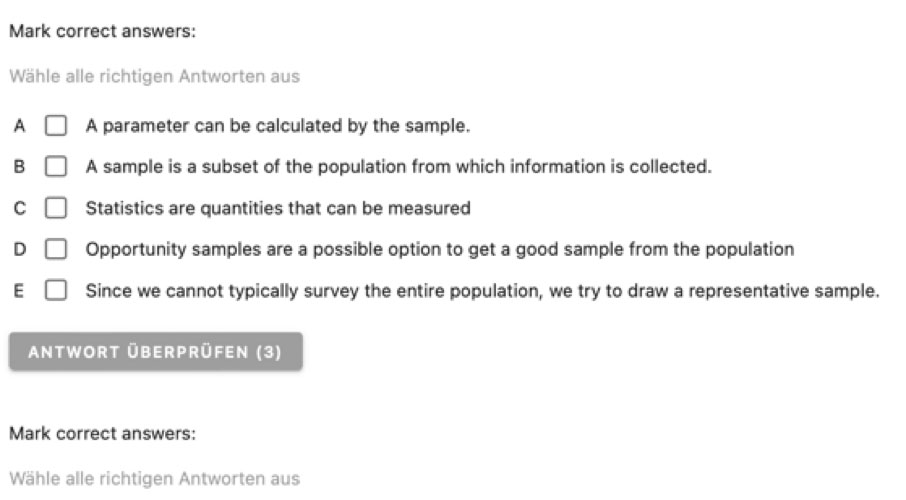
To better disseminate our simulation results to non-statisticians, we design modular educational materials using a blended learning concept. Thereby, both biostatistical basics and specific statistical methods for rare diseases are presented in a didactically meaningful way.

Basically, the aim is to design workshops for a heterogeneous audience as individually and learning-centered as possible. Due to the diverse level of knowledge, a highly adaptive framework was developed, so that, for example, use cases as well as technical details are emphasized for statisticians, while fundamentals of biostatistics are provided for people without an in-depth statistical background (e.g., clinicians).
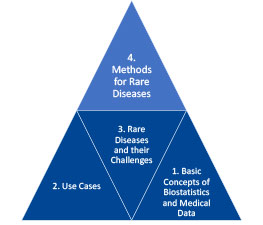
Our teaching concept can be implemented effectively using blended learning. The final goal for all learners is to participate in a joint module in which the methods recommended by EBStatMax will be presented.
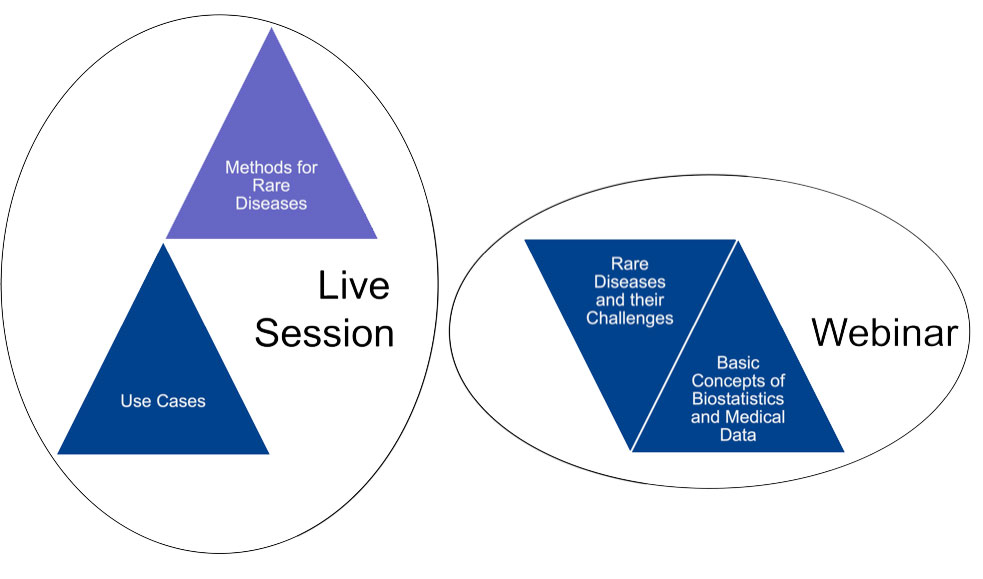
The advantage of the overall structure is that all learners, despite their heterogeneity, can be brought to the same level of knowledge through the individualization options, so that they have the required knowledge for the methodologically focused module. If you are interested in booking a workshop for your research group, etc., please contact Martin Geroldinger, martin.geroldinger@pmu.ac.at
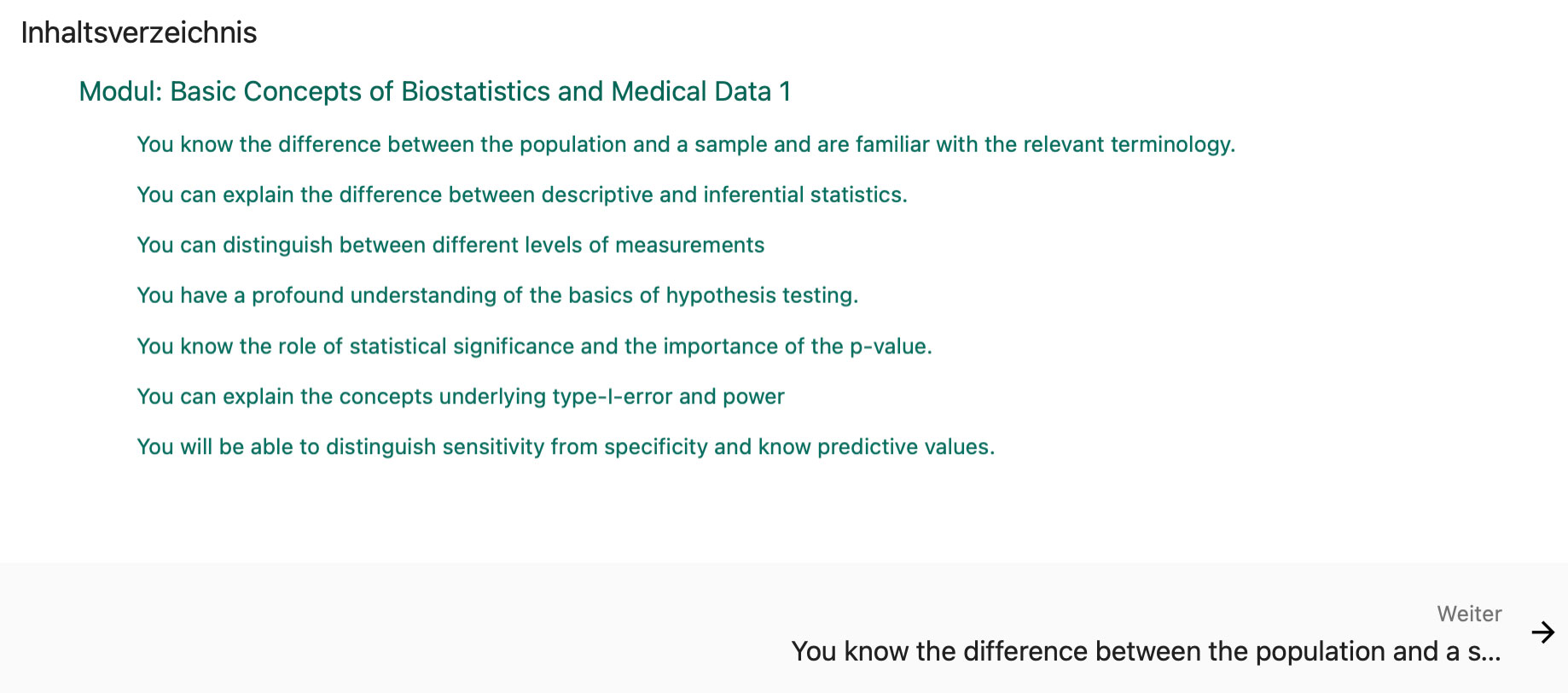
Example of educational materials: Basic concepts of Biostatistics (https://www.geogebra.org/m/ptrzn47c)
The EBStatMax team implemented the Rare Disease Analyser (RDA), a web application that provides a graphical user interface to statistical methods suitable for rare diseases, which have been evaluated as part of the project. Thus, knowledge gained in the project is easily accessible for future research on rare diseases. The RDA provides users with instructions on how to use specific statistical methods in longitudinal studies on rare diseases. Users can perform visual analysis and statistical inference with their data directly in the RDA.

